
Marble Window Sill Sizes, Thickness and How to Measure
Marble window sill sizes explained: standard depths and widths, 3/4 in thickness, edge options, and five simple steps to measure your window before you order.

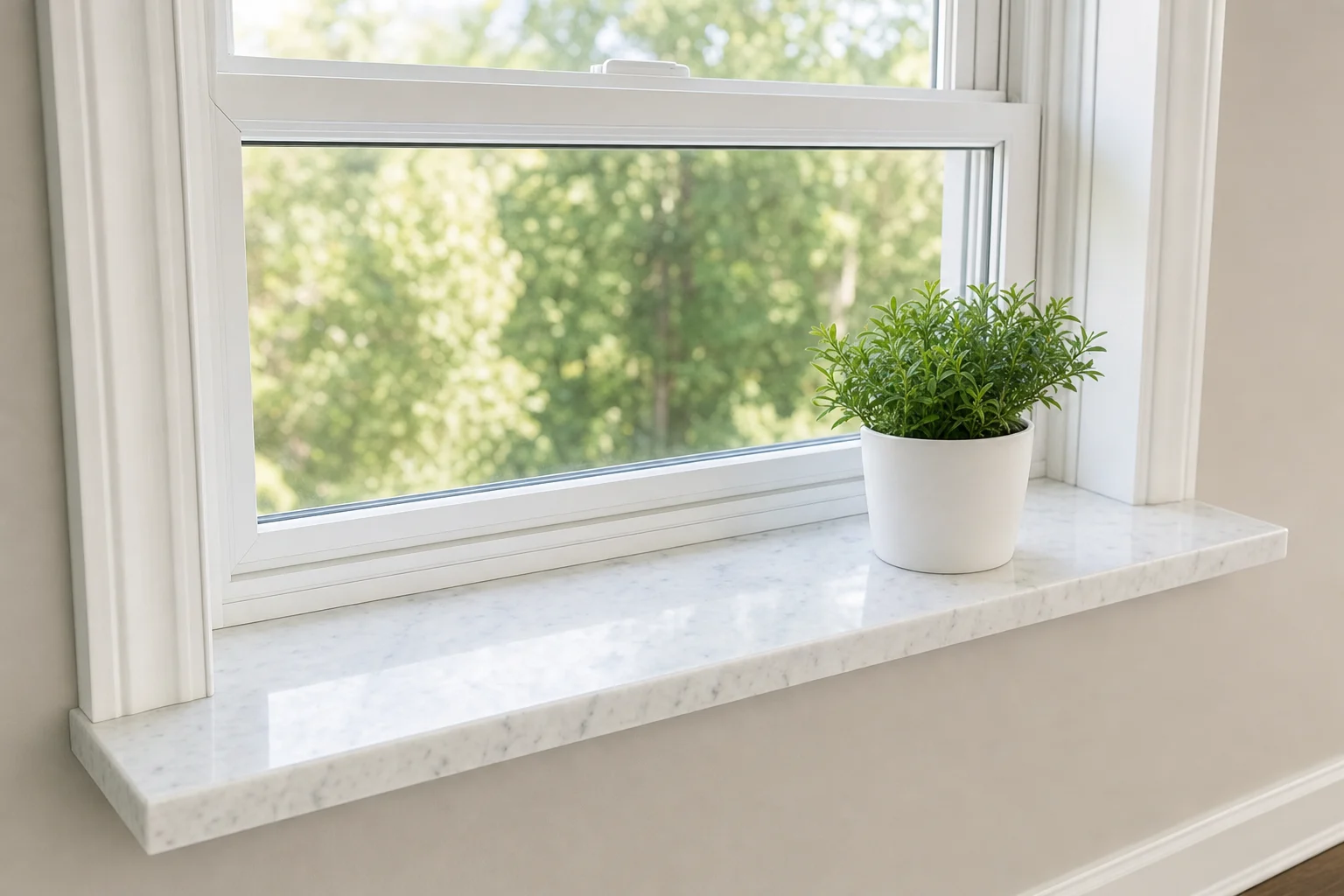
Choosing from the available marble window sill sizes is easier once you know three numbers: the depth, the width and the thickness of the piece. This guide explains the standard sizes we stock, how thick a stone sill is, which edge to pick, and how to measure your window so the sill fits the first time.
A stone window sill is one flat piece that finishes the base of a window opening on the inside of the room. It protects the wall below from condensation and plant pots, and it gives the window a clean, solid ledge.
Depth and Width: What the Two Numbers Mean
Every window sill on our site is sold by two sizes:
- Depth is the short side, measured from the window frame out toward the room.
- Width is the long side, measured from one side of the window opening to the other.
So a sill listed as 6 in x 48 in is 6 inches deep and 48 inches wide.
Standard Marble Window Sill Sizes
Most of our stone window sills, including the Carrara White Marble window sill, come in the same set of standard sizes:
- Depths: 4, 5, 6, 7, 8, 10 and 12 inches
- Widths: 24, 36, 40, 48, 54, 60, 72, 84 and 96 inches
Our White Marble window sill covers smaller openings: depths from 2 to 8 inches and widths of 12, 24, 36, 40 and 48 inches. Each product page shows the sizes available for that stone.
If you prefer a darker or more uniform look, the same sizes are offered in granite and quartz. You can compare every color in the Window Sills category.
How Thick Is a Stone Window Sill?
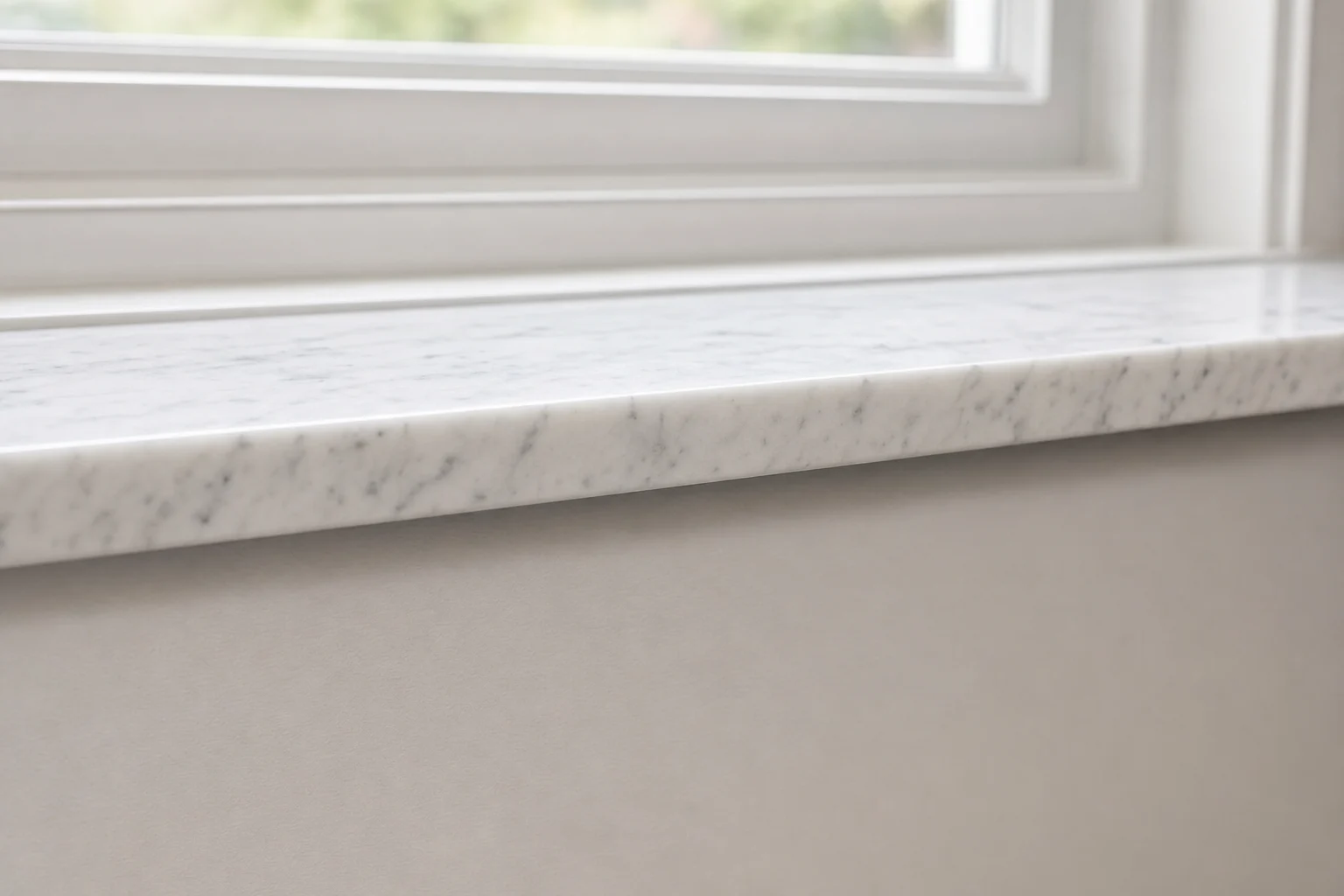
Our window sills are 3/4 inch thick as standard. That is thick enough to feel solid and thin enough to slide under most window frames when you replace an old sill.
On some colors a 1 3/16 inch thickness is offered as a paid add-on for a heavier look. The product page shows it when it is available. For more on choosing a thickness, see our guide to stone thickness.
Edge Options: Eased Edge or Bullnose
The top and the front edge of each sill are finished, because those are the surfaces you see from the room.
- Eased Edge (standard): a square front with the sharp corner lightly softened. It gives a crisp, modern line.
- Bullnose (paid option): the top corner of the front is smoothly rounded and the bottom stays flat, so the sill still sits level. It gives a softer, more traditional look.
How to Measure for a Window Sill in 5 Steps
You need a tape measure, a pencil and a piece of paper. Write every number down in inches.
Step 1: Measure the width
Measure the window opening from side to side where the sill will sit. Measure twice: once at the back, against the window frame, and once at the front. Walls are rarely perfectly square, so the two numbers can differ. If the sill will sit between two walls, use the smaller number.
Step 2: Measure the depth
Measure from the window frame out to the face of the finished wall. Then add the overhang you want in front of the wall. Many installers let a sill project about 1/2 to 1 inch so the front edge shows.
Step 3: Check the height under the window frame
If you are replacing an old sill, measure its thickness, or the gap it leaves under the window frame. A 3/4 inch sill needs at least that much room, plus a little for adhesive.
Step 4: Leave a small gap for fitting
Stone does not bend, so a sill that is exactly as wide as the opening can be hard to set in place. A common practice is to take about 1/8 inch off the width. The small gap is closed with caulk.
Step 5: Pick a standard size or order a custom size
Compare your numbers with the standard sizes above. If one matches, order it as it is. If your window falls between two sizes, choose the next size up and have it cut down to your exact measurements.
When Standard Sizes Do Not Fit
Older homes and bay windows often need a size that is not on the list. With Build Your Window Sill you enter your own depth and width, in decimals or fractions of an inch, and see the price before you add the piece to your cart. A custom sill is cut down from a standard piece, so it can be smaller than the catalog size but not larger.
Our step-by-step guide on how to order a custom size stone piece walks through the whole process.
Marble, Granite or Quartz?
All three are sold in the same sizes, so the choice is about look and care.
- Marble is a natural stone with soft veining. No two pieces are identical. Examples: Carrara White Marble, White Marble and Chelsea Light Grey Marble.
- Granite is a hard natural stone. Our Absolute Black Granite window sill gives a deep, even black.
- Quartz is an engineered stone with a consistent color from piece to piece, in whites, greys, beiges and blacks.
For a closer comparison, read marble vs quartz and matte vs polished stone.
Frequently Asked Questions
What is the most common window sill depth?
It depends on how thick your wall is. Measure from the window frame to the face of the wall and add your overhang. Our standard depths run from 4 to 12 inches to cover most interior walls.
Can I get a sill longer than 96 inches?
96 inches is the longest standard width we list. For a wider window, contact us with your measurements and we will tell you what is possible.
Which sides of the sill are finished?
The top and the front edge. These are the surfaces that face the room.
Can I see the stone before I order?
Yes. Use the Order Sample option on the product page to check the color and finish next to your window trim and wall paint.
Ready to Choose Your Size?
With your depth, width and thickness written down, picking from our marble window sill sizes takes a minute. Browse the Window Sills category for standard pieces, or enter your own numbers in Build Your Window Sill. More answers are on our FAQ page.