
Robot Vacuum Won’t Cross Your Threshold? How to Fix It
Robot vacuum stuck at a doorway? See how high most robots can climb, why a square stone edge stops them, and how a sloped Hollywood saddle lets the robot roll into every room.

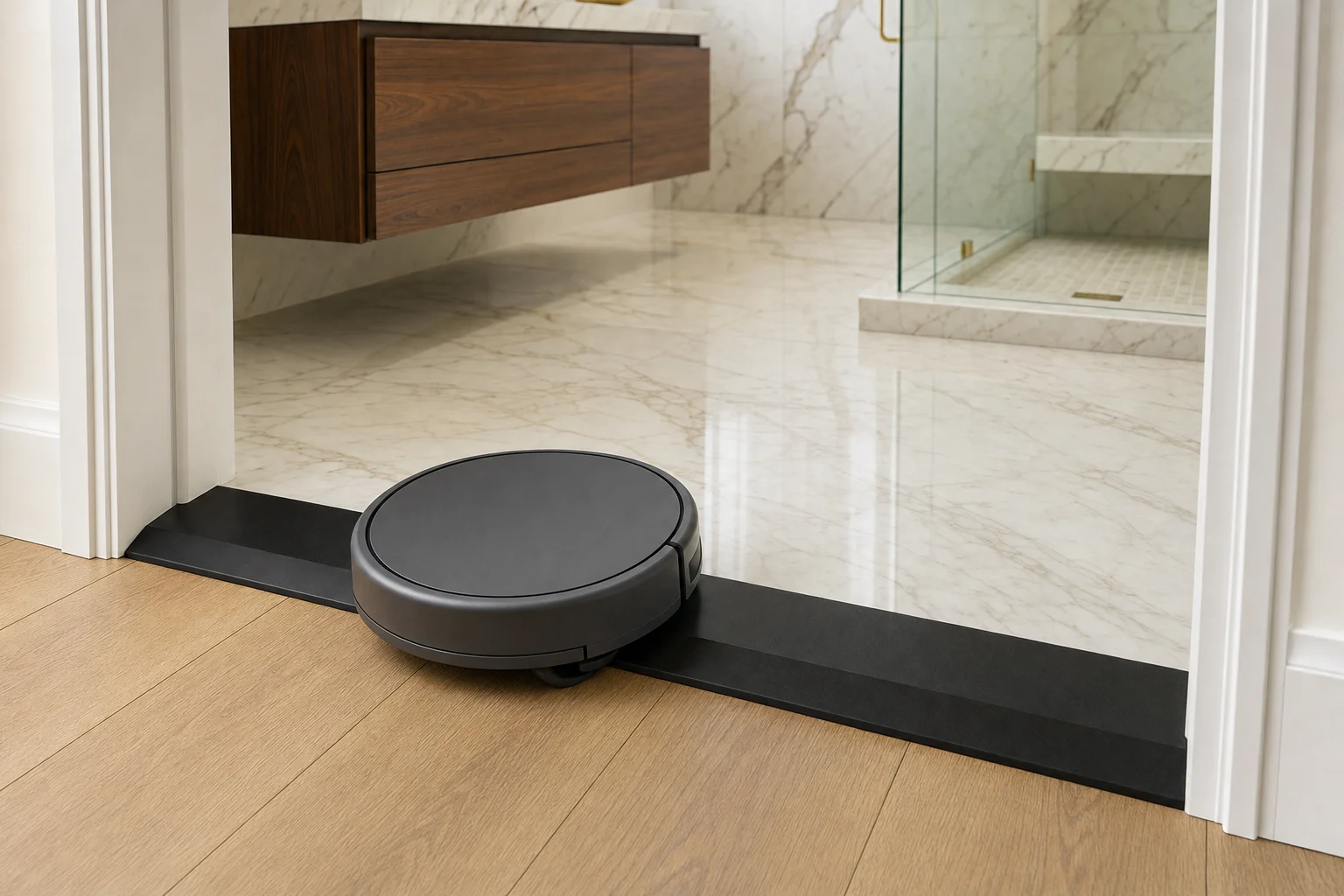
A robot vacuum threshold problem almost always comes down to two things: how high the threshold stands above the floor, and the shape of its edge. Most robot vacuums are built to climb a step of roughly 5/8 to 3/4 inch. A stone threshold with a square edge near that height stops the wheels like a small wall. The same threshold with a sloped edge gives the wheels a ramp to roll up.
This guide shows how to check your doorway in a few minutes, the quick fixes worth trying first, and when replacing the threshold with a sloped Hollywood saddle is the lasting answer.
Why a robot vacuum gets stuck at a doorway
A robot vacuum crosses a bump by driving its two small wheels up and over it. Three things decide whether that works:
- Height above the floor. Not the thickness of the stone, but how far its top sits above the floor the robot is coming from.
- Edge shape. A square, vertical edge has to be climbed all at once. A sloped edge is climbed a little at a time.
- Grip. Dusty wheels, a full bin or a heavy water tank all make climbing harder.
When a robot turns around at the same doorway every day, it is usually not a fault in the robot. The doorway is simply asking for more than the robot was designed to do.
How high a threshold can a robot vacuum cross?
It depends on the model, so check the manual or the maker’s support page for the “obstacle” or “threshold climbing” figure. As a general guide, many popular robots are rated at about 5/8 inch (1.6 cm), and many others at about 3/4 inch (2 cm). Some newer models with lifting wheels or legs can climb more.
Treat the rated figure as a best case. A robot that clears a bump when it is empty can struggle on the way back with a full bin, and most ratings assume a clean, grippy surface.
Measure your doorway first
- Lay a straight edge (a ruler or a level) flat on top of the threshold so it sticks out over the floor.
- Measure the gap from the underside of the straight edge down to the floor. That is the height the robot has to climb.
- Repeat on the other side. The two floors are often at different heights, so the robot may get in but not back out.
- Look at the edge. Is it square, slightly eased, or sloped?
- Compare your tallest measurement with your robot’s rated climbing height.
If your tallest side is well under the rating and the robot still fails, the edge shape or the wheels are the likely cause. If it is at or above the rating, the threshold itself needs to change.
Quick fixes to try before changing anything
- Clean the wheels and the sensors under the robot. Fine dust on the tires takes away grip.
- Empty the bin and the water tank and test again. Less weight means an easier climb.
- Check the app. Some robots have a threshold or obstacle-crossing setting, and some mark a doorway as a barrier after failing a few times. Remapping the room can clear that.
- Move the dock so the hardest doorway is not on the robot’s way home.
- Add a small ramp. Rubber threshold ramps for robot vacuums are sold online. They work, but they sit loose in the doorway and are easy to trip on, so most people treat them as a temporary fix.
The lasting fix: a sloped Hollywood saddle
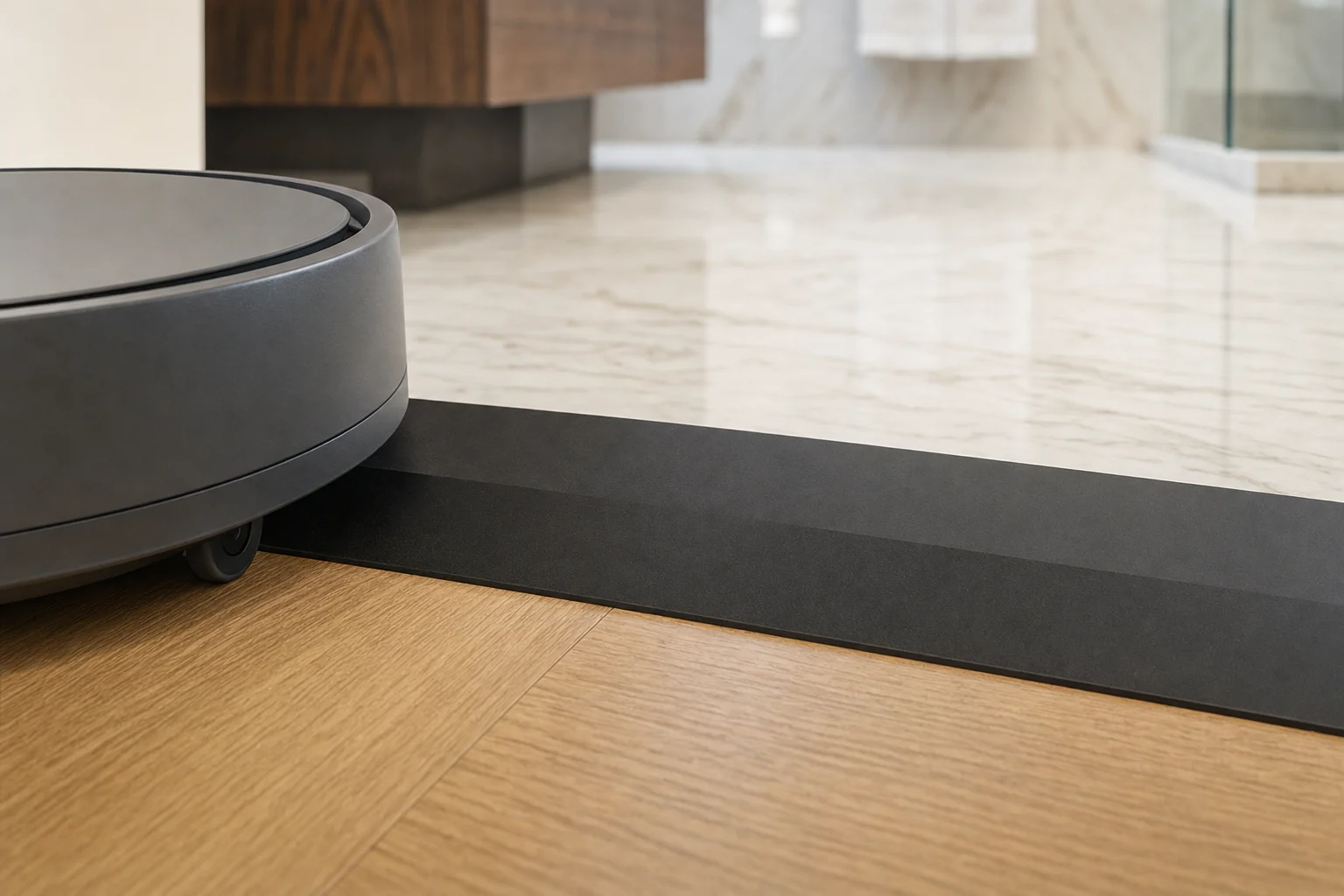
A Hollywood saddle is a stone threshold whose long edge is cut as a slope instead of a square step. The slope tapers down to a thin edge at the floor, so the wheels meet a ramp rather than a wall. This is the most common reason our customers choose a Hollywood edge: they want the robot to reach the bathroom or bedroom without help.
The slope also makes the doorway easier to walk over and to roll a cart or wheelchair across. Our guide to the Hollywood saddle explains the profile in detail.
One honest note: a slope makes the climb much easier, but no threshold can promise that every robot will cross it. The finished height still matters. Keep the top of the stone as low as your floors allow, and compare it with your robot’s rating.
Single or double Hollywood for a robot vacuum threshold?
- Double Hollywood: sloped on both long sides. Choose it when the threshold stands above the floors on both sides, which is the usual case when a robot has to drive in and back out. See the Absolute Black Matte double Hollywood saddle as an example.
- Single Hollywood: one sloped side and one straight side. Choose it when one floor is level with the top of the threshold and only the other floor is lower. The slope faces the lower floor.
If you are not sure which case you have, the measurements from the steps above will tell you: a gap on both sides means double, a gap on one side means single.
Thickness, width and finish tips
- Thickness: our standard is 3/4 inch. A thicker piece sits higher at the doorway, so for a robot-friendly doorway stay with the standard thickness unless your floors need more. See how to choose threshold thickness.
- Width: a wider threshold gives the robot a flat landing on top before it rolls down the other side.
- Finish: a Matte top gives the wheels a little more grip than a Polished one and hides scuffs from daily traffic.
- Installation: ask your installer to set the stone so its top is as close to the finished floors as the doorway allows. Every bit of height you save helps the robot.
Ordering the right size
Measure the doorway length from jamb to jamb and the width the threshold has to cover between the two floors. Browse stock sizes in our saddle thresholds, or use Build Your Threshold to choose your stone, finish and a single or double Hollywood edge, enter your exact size and see your price. Samples are available if you want to see the stone first.
Robot vacuum and threshold FAQ
Will a Hollywood saddle guarantee my robot vacuum can cross?
No threshold can guarantee it for every robot. A sloped edge removes the vertical step, which is what stops most robots, but the finished height above the floor still has to be within what your model can climb.
My robot gets into the room but cannot get out. Why?
The floors are probably at different heights, so the step is taller on one side. A double Hollywood saddle slopes on both sides and helps in both directions.
Is a 3/4 inch stone threshold too high for a robot vacuum?
Not by itself. The stone is 3/4 inch thick, but it is set into the doorway, so the part that stands above the finished floor is usually less. Measure the height above the floor, not the thickness of the stone.
Can I replace an existing marble threshold?
Yes. An installer can remove the old piece and set a new one in the same opening. Measure the opening after you know its true length and width, then order a stock or custom size to fit.
Does the robot damage a stone threshold?
Rubber wheels and soft brushes do not harm granite, marble or quartz in normal use. A Matte finish hides light scuff marks best.
Let the robot reach every room
To solve a robot vacuum threshold problem, measure the height above the floor on both sides, compare it with your robot’s rating, and try the quick fixes. If the doorway still stops the robot, a single or double Hollywood saddle replaces the step with a slope. Order a stock size or a custom cut through Build Your Threshold. Questions? Contact us, call (201) 357-0444 or email sales@platosurfaces.com.